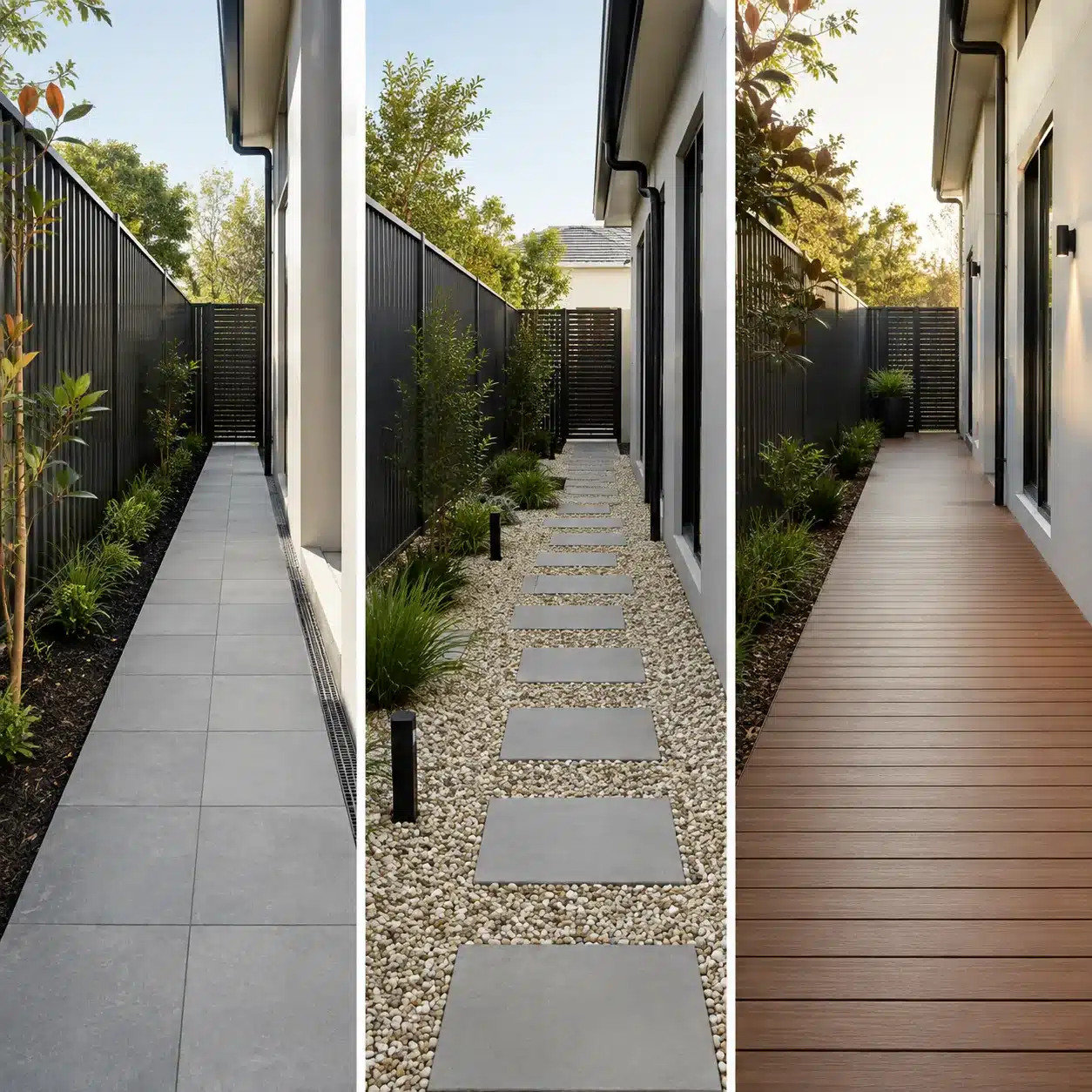
Choosing between paving gravel or decking for a side passage can completely change how that narrow strip beside your Sydney home works. The right surface affects drainage, maintenance, access, cleanliness and even how spacious the passage feels.
For some homes, paving is the obvious answer. In others, gravel solves a drainage problem with far less construction. And where the ground is uneven, shaded or needs to connect with an existing deck, a raised decking solution can make surprisingly good sense.
The best choice therefore isn’t simply the surface you like most. It is the one that suits the way water moves through the site, how often the passage is used and what sits around it.
Quick Comparison: Paving vs Gravel vs Decking for a Side Passage
| Factor | Paving | Gravel | Decking |
|---|---|---|---|
| Walking stability | Excellent | Moderate | Excellent |
| Drainage potential | Depends on design and base | Very good when correctly prepared | Very good beneath a raised structure |
| Maintenance | Low | Moderate | Low to moderate |
| Works on uneven ground | Requires preparation | Reasonably flexible | Very good |
| Wheelie bins and frequent access | Excellent | Less convenient | Excellent |
| Visual character | Structured and architectural | Soft and informal | Warm and contemporary |
| Typical installation complexity | Medium to high | Low to medium | Medium to high |
If you want the shortest answer, paving is usually best for a heavily used side passage, gravel is useful where permeability and budget matter, and decking works particularly well where levels, shade or an existing deck make a raised walkway practical.
1. Start With Drainage Before Choosing the Surface
Before comparing colours, paver sizes or decking boards, watch what happens in the passage during rain.
Side areas often sit between a house wall and boundary fence, receive limited sunlight and contain downpipes, taps, air-conditioning units or service connections. That combination can make them slower to dry than the main garden.
Look for:
- water sitting against the house
- low points where puddles form
- downpipes discharging nearby
- soil that stays damp after rain
- water moving towards doors or subfloor vents
- neighbouring ground that sits higher than yours
A surface should work with the drainage strategy, not disguise a drainage problem underneath it.
Changing the surface does not automatically fix poor drainage. Levels, falls, sub-base preparation and the destination of stormwater still need to be considered.
This is especially important with paved areas. NSW Government guidance identifies paved and other trafficable surfaces as sources of stormwater, so runoff needs to be considered as part of the design rather than after installation.
2. When Paving Is Best for a Side Passage
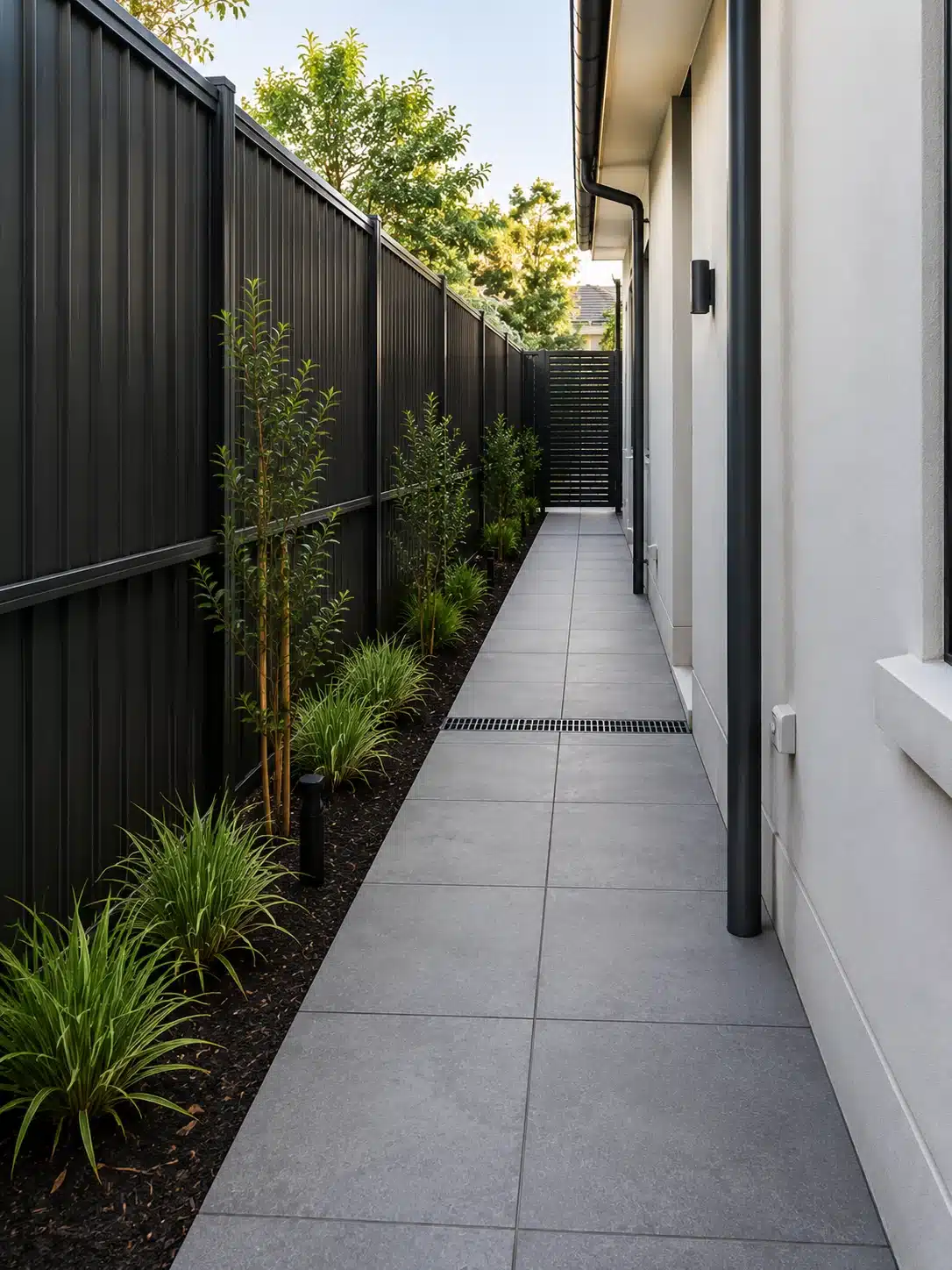
Paving is often the most practical choice when the side passage is a genuine access route rather than an ornamental part of the garden.
A properly built paved path creates a firm, predictable surface for everyday movement. That matters if you regularly take wheelie bins through the passage, move garden equipment, carry furniture to the backyard or simply want to walk through without thinking about what is underfoot.
Paving works particularly well when:
- the passage receives frequent foot traffic
- wheelie bins travel through it every week
- you want a clean route between front and back yards
- the space needs to feel formal or architectural
- you want minimal loose material beside doors
- the ground level allows the paving and base to be constructed correctly
Large-format pavers can also make a narrow side passage feel visually calmer because there are fewer joints and less visual clutter.
For contemporary homes, pale or mid-grey paving beside darker fencing often gives the passage a simple, deliberate appearance instead of making it feel like leftover space.
But paving still needs drainage
Traditional paving should not simply be laid flat from boundary to wall. The finished levels and falls need to direct water appropriately, and drainage may need to be incorporated where runoff cannot safely move into the surrounding landscape.
Permeable paving is another possibility in suitable situations. Proper permeable paving depends not only on the paver itself but also on the base and jointing system beneath it. [oai_citation:4‡blacktown.nsw.gov.au](https://www.blacktown.nsw.gov.au/files/assets/public/wsud/inspection-amp-maintenance-sheets/permeable-paving.pdf)
3. When Gravel Is Better
Gravel gives a side passage a softer, more relaxed appearance and can be particularly useful where you want water to move through the surface rather than immediately run across it.
It also works beautifully with stepping stones, narrow planting beds and dark boundary fencing.
Gravel suits side passages where:
- traffic is relatively light
- drainage is an important consideration
- you want to retain a softer garden character
- the passage contains planting rather than being purely functional
- you want a relatively simple surface treatment
- future access beneath the surface may be useful
A combination of gravel and large stepping pavers is often more practical than loose gravel alone. The pavers create stable places to step while the gravel visually fills the passage and allows the design to feel less heavily constructed.
Gravel is not completely maintenance-free
One common misconception is that gravel can simply be spread over soil and forgotten.
Without suitable preparation and edging, gravel can migrate into garden beds, develop uneven spots and become mixed with soil or organic debris. Weed growth can also become frustrating if the base has not been prepared properly.
Gravel may also be less convenient if wheelie bins travel through the passage every week. Small wheels tend to move much more comfortably over a continuous paved or decked surface.
4. When Decking Makes More Sense
Decking is sometimes overlooked for side passages because homeowners associate decks with entertaining areas.
But a narrow deck can work extremely well as a raised walkway.
This is particularly useful where the side yard has awkward ground levels or connects directly to an existing rear deck.
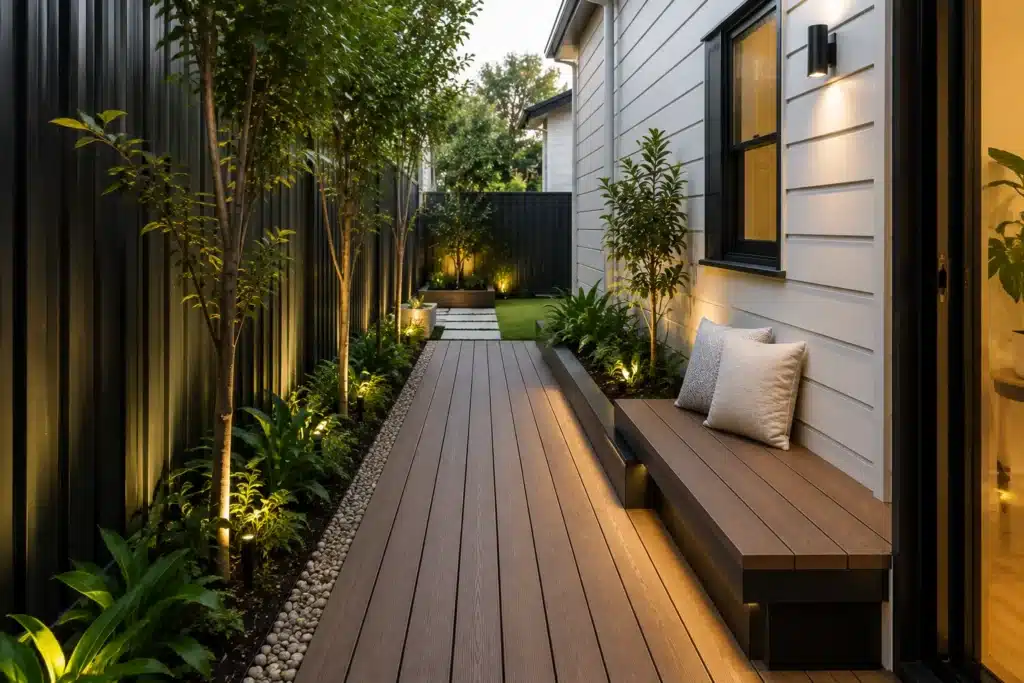
Arianya’s own Eastwood project is a good example: an underused side yard was transformed using composite decking together with garden planting and decorative stone. [oai_citation:5‡Arianya Landscapes](https://arianya.com.au/projects/eastwood-nsw-side-yard-decking-transformation/?utm_source=chatgpt.com)
Consider decking when:
- the existing ground is uneven
- the passage must transition between different levels
- you want continuity with a backyard deck
- the ground underneath needs room for drainage
- the space is narrow and you want strong linear visual lines
- you prefer a warmer finish than stone or concrete
Composite decking can be especially attractive in narrow side passages because it avoids some of the ongoing refinishing associated with exposed natural timber.
However, shaded decking still needs sensible detailing. Water should be able to drain below the structure, air needs to move beneath it, and leaves or debris should not be allowed to accumulate indefinitely in damp areas.
5. Think About Shade and Drying Time
A side passage that receives one or two hours of direct summer sun can behave very differently during winter.
Walls and fences create shade, while neighbouring buildings and vegetation can further reduce airflow.
This makes surface choice particularly important.
Paving in shade
Paving provides a solid walking surface, but a damp shaded area can collect dirt and organic growth if water constantly remains on the surface. Good falls and drainage therefore matter.
Gravel in shade
Gravel allows water to move through the upper surface, which can make it useful in damp-looking passages. However, wet leaves and organic matter can gradually work into the stone and require occasional cleaning or replenishment.
Decking in shade
A raised deck keeps the walking surface above the underlying soil, which can be extremely useful. The cavity below it, however, should not become an enclosed damp pocket.
This is one reason we recommend assessing sunlight, drainage and ventilation together rather than choosing a material from a sample alone.
6. Consider What Has to Travel Through the Passage
Ask a very ordinary question: What actually goes through this side yard?
The answer can eliminate one material almost immediately.
If the passage is used for bins, bicycles, lawn mowers or trades access, a firm continuous surface usually wins.
For example:
- Wheelie bins: paving or decking
- Occasional pedestrian access: all three options
- Garden-only path: gravel with stepping pavers can work beautifully
- Bicycles: paving or decking
- Heavy garden equipment: properly constructed paving is usually easiest
- Barefoot connection to a pool or entertaining deck: decking or smooth paving
This practical test is often more useful than comparing materials on appearance alone.
7. Match the Surface to the Rest of the Landscape
A side passage should feel connected to the house and garden rather than designed as an isolated strip.
Look at the materials that already exist at both ends.
If your front entry uses large stone pavers and the backyard continues with paved entertaining areas, extending that paving language through the side yard can create continuity.
If the side passage leads directly onto a composite deck, using the same or a complementary decking board can visually connect the two spaces.
And if the garden already has informal planting, natural stone and soft landscape elements, gravel may feel more appropriate than introducing another hard paved surface.
A professional landscape construction plan can also combine materials instead of forcing one finish across the entire passage.
Can You Combine Paving, Gravel and Decking?
Absolutely. In many side passages, the best result is not choosing a single material.
Useful combinations include:
- large stepping pavers surrounded by decorative gravel
- a paved utility zone beside taps and bins with gravel further along
- decking at a raised doorway transitioning into paving
- a composite deck walkway edged with gravel and planting
- pavers with narrow permeable gravel bands
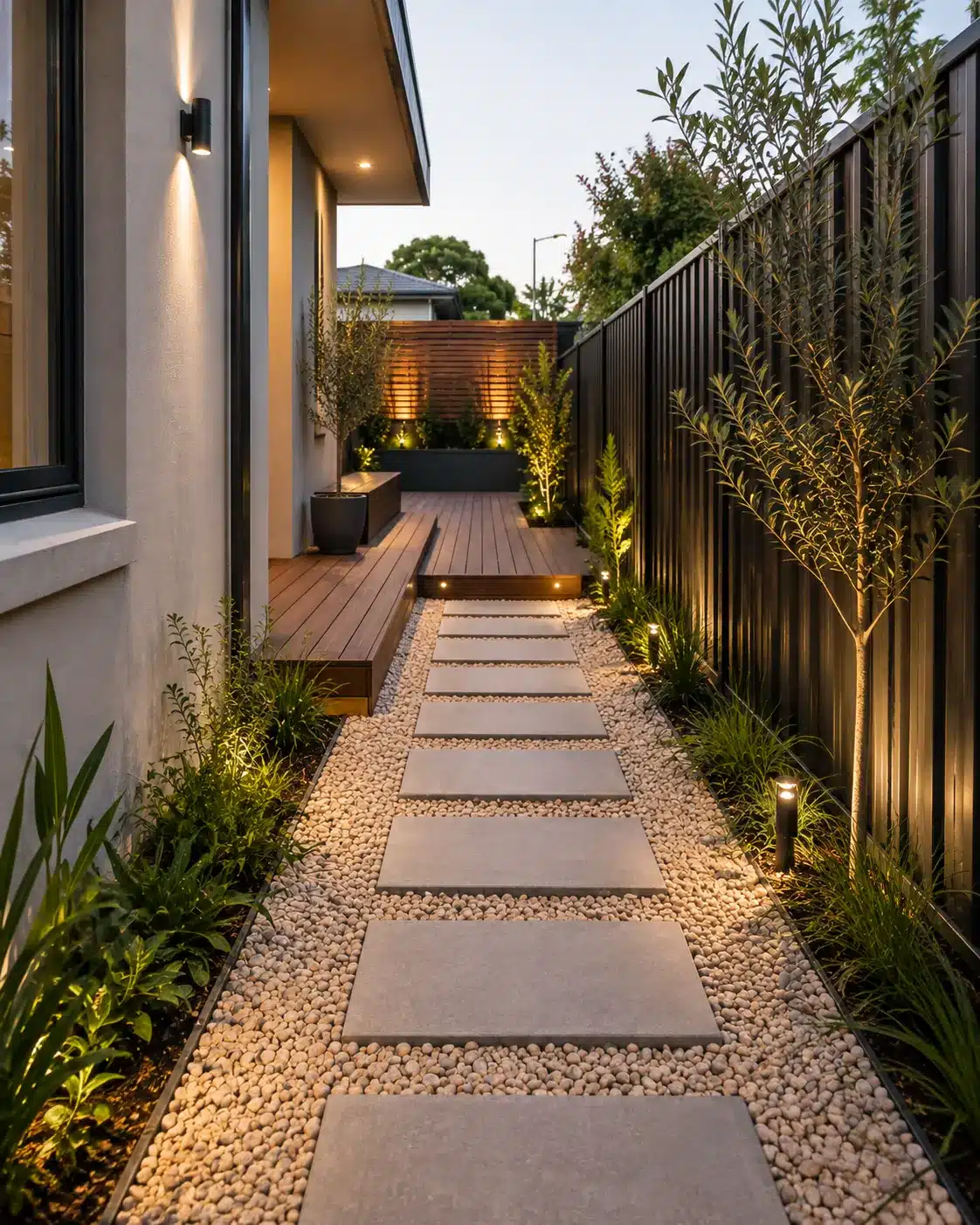
Using two materials can make a narrow space more interesting without making it busy, provided the palette remains simple.
Which Option Is Usually the Cheapest?
Gravel normally involves the simplest material system of the three, but comparing only the visible surface can be misleading.
The real cost depends on excavation, spoil removal, drainage, access, edging, base preparation and existing levels.
For example, a gravel path on already suitable ground may be straightforward. The same path on a wet clay side yard with poor drainage may require considerably more preparation.
Similarly, paving costs more than just the pavers themselves, while decking requires a supporting structure below the boards.
Instead of choosing by square-metre material price alone, compare the complete installed solution required to make the passage reliable.
Which Surface Requires the Least Maintenance?
For most busy households, properly installed paving is likely to feel the most straightforward over time.
It provides a hard surface that can be swept or washed and does not contain loose aggregate.
Composite decking is also relatively low-maintenance, although debris still needs to be cleared and the area below or around the deck needs to remain functional.
Gravel has fewer structural components but normally requires more occasional tidying because individual stones can move and organic material can collect between them.
| If Your Priority Is… | Start By Considering… |
|---|---|
| Easy bin access | Paving |
| A softer garden appearance | Gravel |
| Managing an awkward level change | Decking |
| A formal contemporary path | Paving |
| Keeping more of the surface visually permeable | Gravel or permeable paving |
| Connecting directly with an existing deck | Decking |
| A combination of practicality and softness | Pavers set within gravel |
What Is the Best Surface for a Sydney Side Passage?
There isn’t one surface that wins for every Sydney property.
Paving is usually the strongest all-round choice for a frequently used side access. It is stable, clean and easy to move bins or equipment across.
Gravel is appealing when drainage, visual softness and lighter construction are priorities. It works particularly well with stepping stones and planting.
Decking deserves serious consideration where the ground is uneven, the passage connects with an existing deck or a raised walkway solves a difficult level change.
The deciding factor should be the site itself: ground level, drainage, shade, access requirements and the landscape surrounding the passage.
If you’re still planning the wider space, our guide to narrow side yard landscaping ideas for Sydney homes explores planting, lighting, storage and other ways to make a tight passage more useful.
For a side passage that needs new paving, decking, drainage or a complete landscape redesign, Arianya Landscapes can assess the existing conditions and design the surface as part of the whole outdoor space rather than treating it as an isolated path.
For NSW homeowners considering new pathways or paving, it is also worth checking the current NSW Planning Portal guidance for driveways, pathways and paving before construction.