
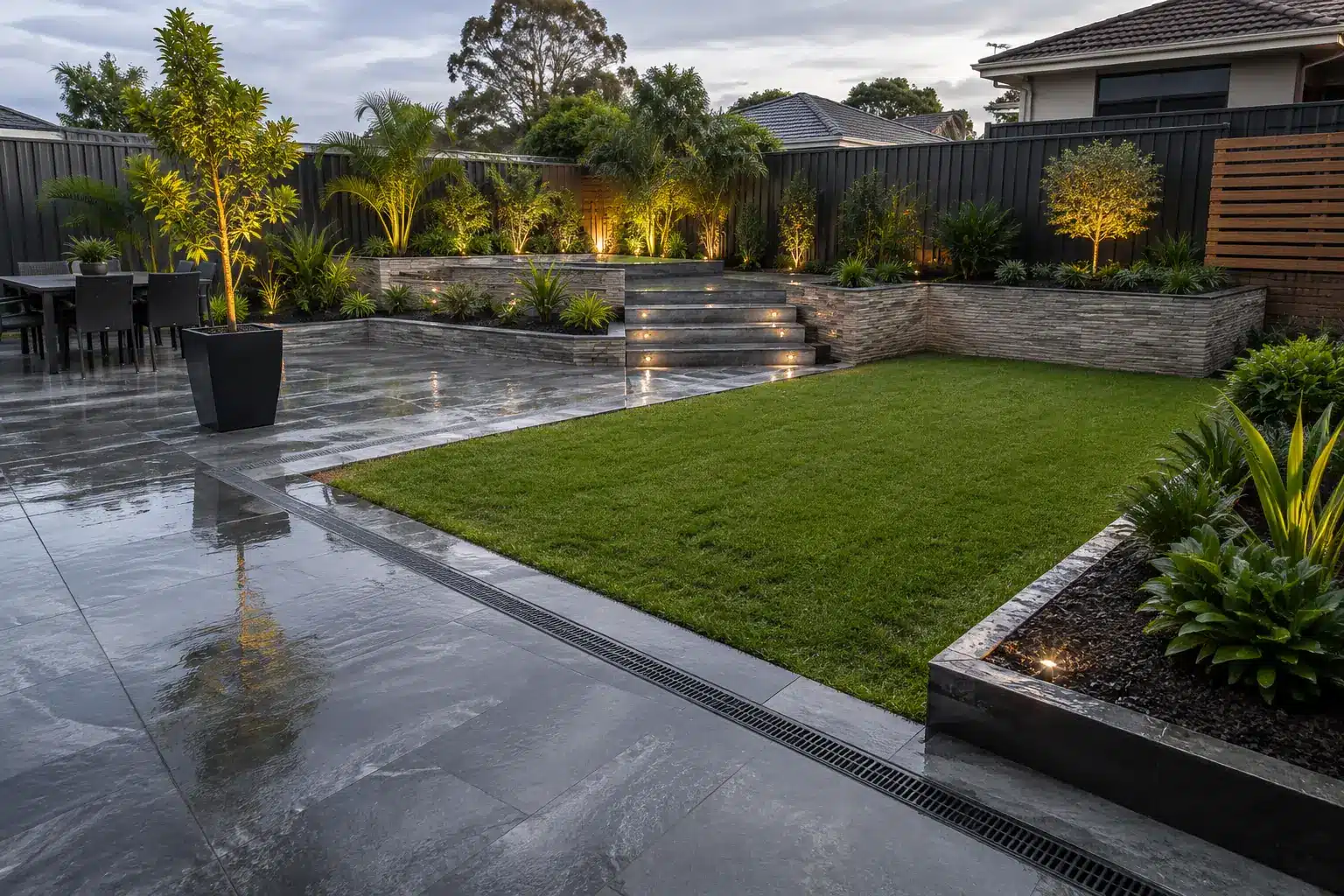
Backyard drainage Sydney homeowners can rely on starts with understanding where rainwater comes from, where it travels and where it should safely leave the property. If water regularly pools across your lawn, collects beside paving or leaves garden beds wet for days, the problem is often more than an inconvenience. Poor drainage can affect plants, lawns, paving, retaining walls and the usability of your outdoor space.
Sydney backyards vary enormously. One property may sit on a steep block where water moves too quickly, while another may have compacted soil where rain struggles to soak in at all. Add roofs, patios, paving and other hard surfaces, and a large amount of water may need to be managed during heavy rain.
The right solution therefore isn’t simply to install a drain wherever a puddle appears. Good backyard drainage considers levels, soil, surface materials, water flow and the overall landscape design.
Below, we explain nine practical backyard drainage solutions for Sydney homes, when each one can help, and how drainage can be incorporated into a landscape without making the garden look like an engineering project.
Why Backyard Drainage Matters in Sydney
Rain falling onto garden soil can gradually soak into the ground. Rain landing on roofs, driveways, paving and other hard surfaces behaves differently. It becomes runoff and moves toward lower parts of the property.
Sydney Water explains that hard urban surfaces such as roofs, roads and footpaths prevent rainfall from soaking directly into the ground, creating stormwater that eventually moves through property drainage, gutters, pipes, channels and waterways.
For homeowners, that makes drainage an important part of landscape planning rather than something to consider only after a backyard has been completed.
Common signs that your garden drainage may need attention include:
- puddles remaining long after rainfall has stopped;
- a lawn that stays soft, muddy or waterlogged;
- water collecting between paving and garden beds;
- soil washing away during heavy rain;
- mulch repeatedly moving out of garden beds;
- water flowing toward the house instead of away from it;
- persistently wet areas around retaining walls;
- moss or algae developing on frequently damp hard surfaces; and
- plants struggling in areas that remain excessively wet.
1. Correct the Backyard Levels and Surface Falls
One of the most important backyard drainage Sydney principles happens before a drain is installed: make sure water has somewhere sensible to travel.
A backyard may appear almost flat while still containing small depressions that collect water. Poor grading can also cause runoff to move toward the house, patio or another area where it becomes trapped.
Landscape grading reshapes the surface so rainfall is encouraged to move toward suitable collection points or drainage infrastructure.
This may involve:
- removing small low spots;
- adjusting soil levels;
- building consistent falls into paved areas;
- reshaping lawn areas;
- coordinating levels around retaining walls; and
- directing surface water toward appropriate drainage points.
This is why drainage should ideally be considered during the early stages of landscape construction. Arianya’s landscape construction process includes rough grading and drainage installation as part of preparing the foundations of an outdoor space.
2. Install a French Drain for Persistently Wet Ground
A French drain can be useful where water moves through soil or repeatedly saturates a particular section of the backyard.
In simple terms, it usually consists of a trench containing drainage aggregate and a perforated drainage pipe. Water enters the drainage zone and is carried away rather than remaining trapped in the surrounding soil.
French drains are particularly useful around:
- soggy lawn edges;
- garden beds;
- low sections of a yard;
- areas near retaining walls; and
- landscapes where subsurface water is contributing to wet ground.
However, a French drain still needs a suitable destination for the collected water. Installing a perforated pipe without understanding where that water will ultimately discharge is not a complete drainage strategy.
3. Use Strip or Channel Drains Around Paving
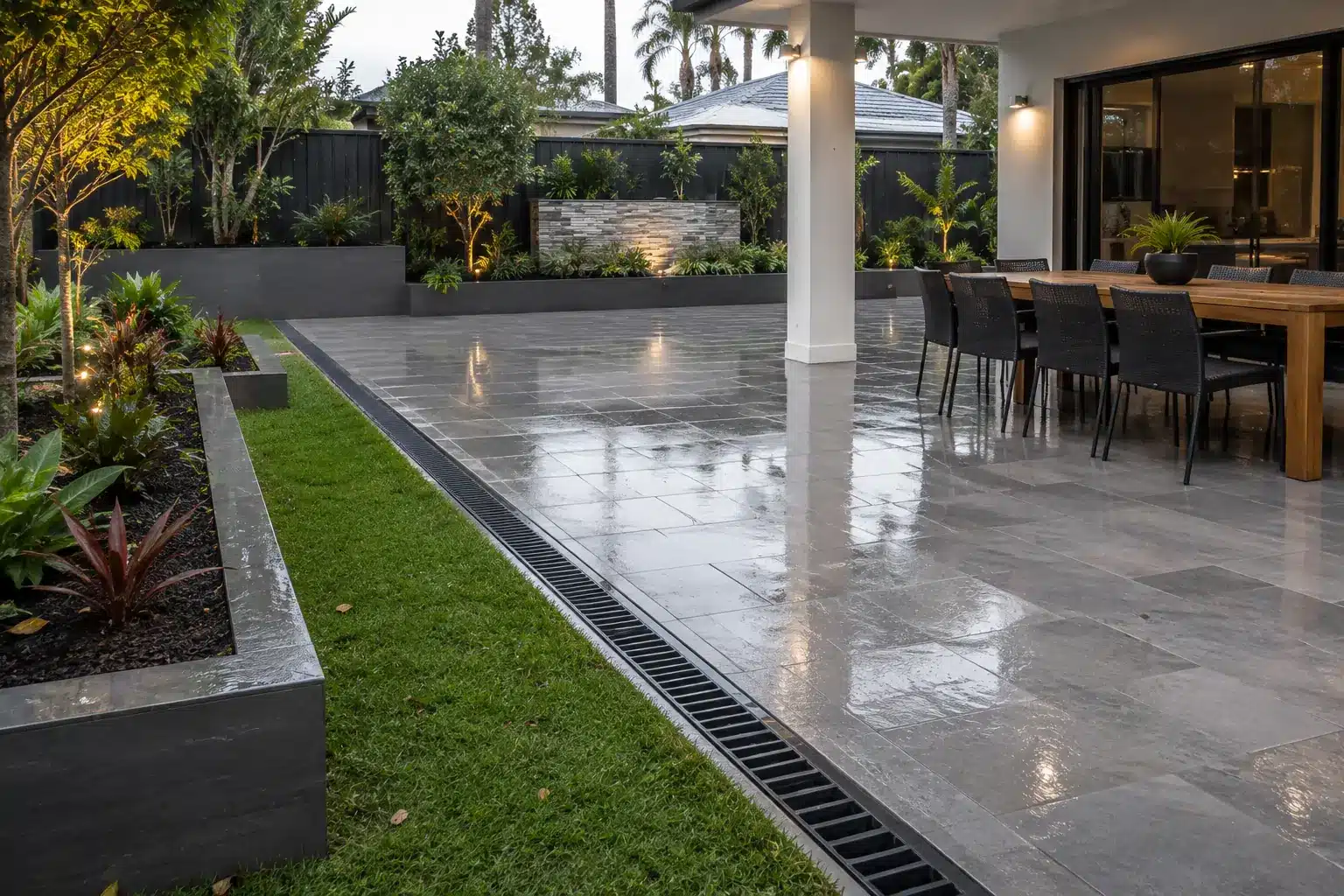
For paved patios, entertaining areas and paths, surface water may need to be captured before it reaches a doorway, lawn or garden bed.
A channel drain — sometimes called a strip drain or trench drain — creates a narrow collection point across the surface. The grate remains visible while the drainage channel below captures runoff.
They can be especially useful:
- along the edge of patios;
- between paving and buildings;
- across certain pathways;
- around outdoor entertaining spaces; and
- where water naturally reaches the lowest edge of a paved surface.
Drain location should work together with the fall of the paving. A channel drain cannot perform properly if the surrounding surface directs water somewhere else.
If you are replacing or building a paved outdoor space, integrating drainage during the paving installation is generally much cleaner than trying to solve the problem after every paver has been laid.
4. Add Surface Pits at Natural Low Points
Drainage pits can collect water at deliberately created low points within a landscape.
Rather than allowing runoff to spread across the garden, the surrounding levels are designed so water travels toward the pit. From there, it can enter the appropriate drainage system.
They are commonly considered for:
- lower sections of a backyard;
- large paved areas;
- areas where several surface falls meet;
- courtyards; and
- locations receiving runoff from multiple parts of a landscape.
The key is positioning. A pit placed in the wrong location may remain almost dry while water continues pooling elsewhere.
5. Consider Permeable Surfaces Where Appropriate
Not every drop of rain needs to become fast-moving surface runoff.
Traditional impermeable surfaces restrict how much water can soak directly into the ground. In suitable locations, permeable landscape materials can help water infiltrate rather than immediately running across the surface.
Options can include:
- permeable paving systems;
- gravel areas;
- stepping stones with permeable joints;
- mulched garden beds; and
- appropriately designed planted areas.
This does not mean replacing every paved area with gravel. The goal is to balance practical hard landscaping with surfaces that allow water to behave more naturally where site conditions permit.
6. Create a Rain Garden for a Landscape-Led Solution
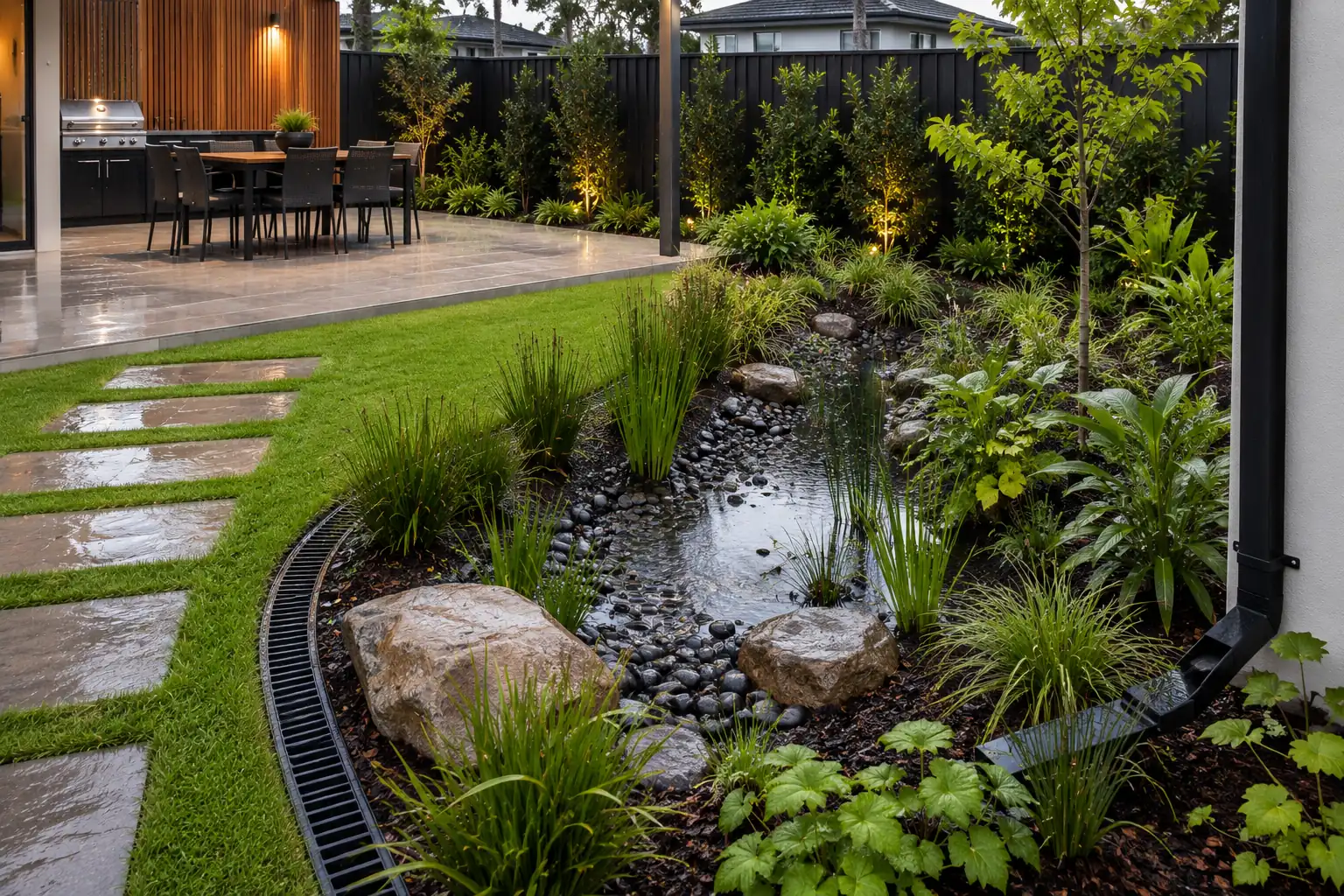
A rain garden is a planted depression designed to temporarily receive and manage runoff.
Rather than treating water purely as something that needs to disappear into a pipe as quickly as possible, a properly designed rain garden uses planting, soil and levels to slow and manage water within the landscape.
It can also become a strong visual element.
A rain garden may suit homeowners who want their garden drainage Sydney solution to contribute to the overall landscape instead of relying only on visible grates and channels.
Plant selection matters because conditions can alternate between wet periods after rainfall and much drier periods between storms. The size, soil structure and overflow arrangement also need to suit the amount of runoff entering the area.
For more information about managing residential stormwater through landscape design, the Australian Government’s YourHome resource provides a useful overview at YourHome: Stormwater.
7. Improve Drainage Around Retaining Walls
Retaining walls need more than a strong visible face. Water can accumulate within the soil behind the wall, so drainage should be considered as part of the retaining-wall system.
Depending on the design, drainage may involve:
- free-draining aggregate;
- appropriate drainage pipework;
- filter materials or geotextiles;
- correct backfill; and
- a suitable outlet for collected water.
Drainage is particularly important on sloping Sydney blocks where retaining walls and level changes are used to create usable terraces.
If you are planning a new wall, it is far better to address the drainage while the wall is being designed and constructed rather than after signs of water pressure or erosion appear. You can see Arianya’s approach to retaining wall installation in Sydney for related landscape-construction options.
8. Address Compacted Soil and Waterlogged Lawn Areas
Sometimes a backyard drainage problem is not caused by a missing drain. The problem may be the soil itself.
Heavily compacted soil can restrict infiltration, particularly in areas that have experienced construction traffic, repeated foot traffic or years of compression.
Possible landscape responses may include:
- soil improvement;
- aeration where appropriate;
- correcting the soil profile before new turf is laid;
- eliminating depressions in the lawn;
- improving subsoil drainage where required; and
- selecting planting suited to the site’s conditions.
If the lawn is continually wet, replacing the turf alone may only hide the problem temporarily. The reason water is staying in the area should be addressed first.
9. Combine Several Backyard Drainage Solutions
The most effective backyard drainage Sydney projects often use more than one method.
Imagine a sloping backyard with a paved entertaining area at the house, lawn in the middle and a retaining wall at the rear.
A complete drainage strategy might use:
- correct paving falls near the house;
- a channel drain at the patio edge;
- surface grading across the lawn;
- subsurface drainage through a persistently wet section; and
- drainage behind the retaining wall.
Each component manages a different part of the water movement.
This is usually more effective than placing one large drain in the backyard and expecting it to fix every drainage issue.
Which Backyard Drainage Solution Is Best?
| Drainage problem | Possible solution | Common application |
|---|---|---|
| Water pooling in soil or lawn | French drain or improved grading | Lawns, garden edges and low areas |
| Water running across paving | Channel or strip drain | Patios, paths and outdoor entertaining areas |
| Runoff collecting at one low point | Surface drainage pit | Courtyards, lawns and paved areas |
| Too much hard-surface runoff | Permeable surfaces | Paths, paving transitions and garden zones |
| Runoff suitable for landscape treatment | Rain garden | Planted landscape areas |
| Wet soil behind a retaining wall | Retaining-wall drainage | Sloping and terraced backyards |
| Waterlogged or compacted lawn | Soil improvement plus drainage assessment | Existing or newly turfed areas |
What Not to Do When Fixing Backyard Drainage
Some drainage problems become more expensive because the visible symptom is treated without fixing the cause.
Don’t Simply Add Soil Over a Wet Area
Adding topsoil may temporarily remove a depression, but it will not fix an underlying drainage problem if water continues flowing into the same location.
Don’t Install a Drain Without Planning Its Outlet
Collecting water is only part of the job. You also need to understand where the collected water can appropriately go.
Don’t Ignore Paving Levels
Excellent drainage hardware cannot compensate for badly designed surface falls. Paving, drainage and finished levels need to work together.
Don’t Redirect Water Towards the Neighbour
Changing your landscape should not create a new runoff problem on adjoining land. Local requirements can apply to how stormwater is managed and discharged.
Don’t Wait Until the Landscaping Is Finished
Drainage is easiest to coordinate while excavation, grading, paving and retaining-wall work are already taking place. Retrofitting drainage through a completed garden can mean disturbing surfaces that were only recently finished.
Backyard Drainage and Sydney Stormwater Requirements
There is an important distinction between improving how water moves through your landscape and altering a property’s formal stormwater drainage system.
Local requirements can vary depending on the property and the type of work being carried out. Sydney Water manages parts of Greater Sydney’s wider stormwater network, while councils also manage stormwater infrastructure and requirements within their areas.
For example, Sydney Water provides a stormwater catchment map showing areas that drain into its stormwater assets.
If your proposed work changes stormwater connections, significantly alters site drainage or involves a complicated flooding problem, check the requirements that apply to your property and obtain professional advice before proceeding.
Planning Drainage as Part of Your Landscape Design
The best drainage is often the drainage you barely notice.
A well-planned landscape can integrate falls, pits, channels, planting, paving and retaining-wall drainage so these elements work together without dominating the garden.
That is why drainage should be considered alongside:
- where the entertaining area will sit;
- how high the paving will be;
- where garden beds will go;
- how lawns will be graded;
- whether retaining walls are needed;
- where roof and surface runoff currently travels; and
- where water can legally and safely be discharged.
When these decisions are made together, drainage becomes part of the landscape rather than an afterthought.
If you are redesigning a backyard rather than simply repairing one wet area, Arianya’s landscape design services can help coordinate functionality, levels, materials and planting before construction begins.
When Should You Get Professional Help?
A small isolated low spot can sometimes have a straightforward cause, but larger drainage problems deserve closer investigation.
Professional assessment is worth considering when:
- water regularly flows toward the house;
- large areas remain waterlogged;
- the property is steep or heavily terraced;
- retaining walls are involved;
- new paving or major landscaping is planned;
- stormwater pipes or formal drainage connections may need alteration;
- runoff from neighbouring or higher land is involved; or
- the source of the water is unclear.
A drainage solution should solve the water problem while still supporting the way you want to use the garden.
Creating a Drier, More Usable Sydney Backyard
Good backyard drainage Sydney design is not about installing as many drains as possible. It is about controlling how water enters, moves through and leaves an outdoor space.
For some gardens, correcting surface levels may make the biggest difference. Others may need channel drains beside paving, subsurface drainage through wet soil, drainage behind retaining walls or a combination of several solutions.
Addressing these issues during a wider landscape project also allows drainage to work with the paving, lawn, garden beds and structures around it.
If persistent pooling, erosion or waterlogged areas are making your backyard difficult to use, Arianya Landscapes can assess the outdoor space and incorporate practical drainage into a broader landscape construction solution in Sydney.


One response to “9 Proven Backyard Drainage Sydney Solutions for a Healthier Garden in 2026”
Have questions? Feel free to ask. Our experts will guide you as soon as possible.